
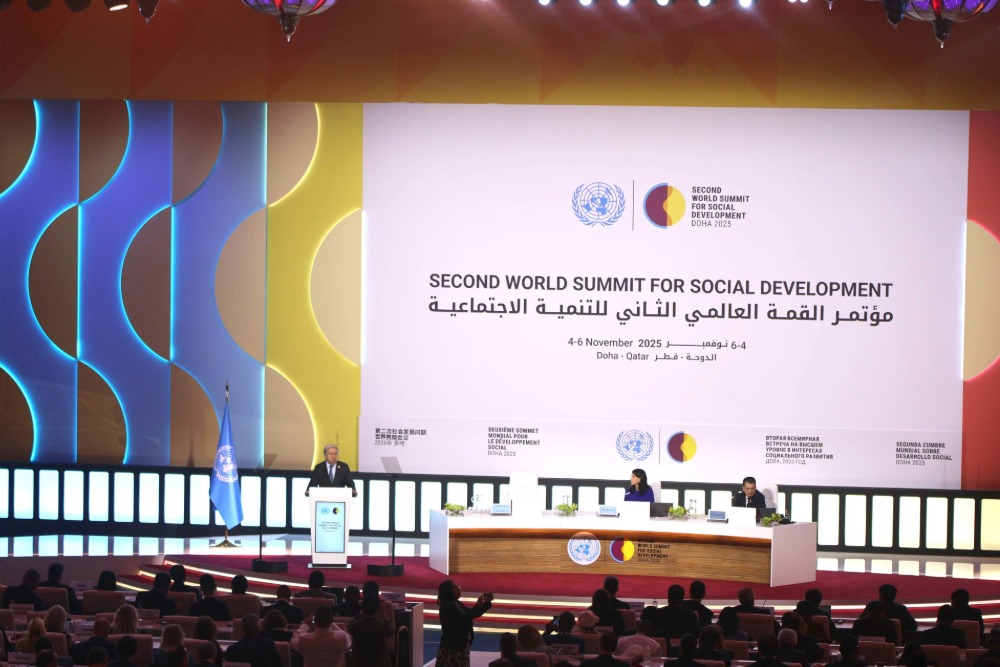
The Second World Summit for Social Development, taking place in Doha 30 years after thelandmark 1995 World Summit for Social Development in Copenhagen, convenes governments, international organizations, civil society and the private sector to strengthen international cooperation for inclusive social development.
The Doha Political Declaration, adopted during the Summit, opens with a strong recommitment to the 1995 Copenhagen Declaration and the 2030 Agenda. The Declaration highlights three interlinked priorities – poverty eradication, full and productive employment and decent work for all, and social integration – as essential to achieving social development. Leaders emphasize that social justice and development are inseparable from peace, security and human rights.
Workers’ priorities in the Declaration
The Declaration is a decisive win for workers and includes strong commitments to the priorities of the trade union movement, such as living wages and universal social protection, and embeds the principles of decent work throughout, including young workers. This unequivocal commitment to “strengthen labour market institutions and social dialogue , including through promoting respect for international labour standards and workers’ rights , as well as promoting, protecting, and investing in mechanisms for social dialogue, freedom of association and collective bargaining ” makes the document a strategic advocacy tool for social development.
The Declaration is also a win for equality and inclusion. It includes a strong commitment to gender equality in the world of work in alignment with the Beijing+ 30 Declaration, emphasizing investment in care and care workers’ rights, equal pay for work of equal value, and the elimination of gender-based violence and harassment in the world of work.
The importance of labour standards is recognized for all workers, including migrant workers, tackling head on the damaging impact of racism, racial discrimination, and xenophobia on social justice, and social cohesion. The text commits to guaranteeing rights for “those in precarious employment and migrant workers, including women migrant workers” and acknowledges the important nexus between international migration and social development. A specific reference is also dedicated to safeguarding workers’ rights in the context of digital technologies, in line with the ITUC call for new ILO standards for platform workers.
These commitments are not addressed in a vacuum and recognize the complementarity of Doha with other UN led processes and the need for policy coherence. The Declaration welcomes the ambitious package of reforms and actions under the Sevilla Commitment to reform the international financial architecture, to extend social protection coverage by at least 2 percentage points per year, to engage constructively in the negotiations on the UN framework convention on international tax cooperation, to find fair and timely solutions that address sovereign debt challenges, and to scale up official development assistance (ODA).
Social Justice, democracy and Multilateralism
The Declaration is also a welcome ally for workers in their struggle for democracy. The text recognises the fundamental nexus between social justice and democracy and how “ social justice cannot be attained in the absence of peace and security or in the absence of respect for all human rights and fundamental freedoms”.
The need to strengthen the multilateral system and its institutions, with the United Nations and its Charter at the centre, is explicitly included in the Declaration. The system must be “fit for the present and the future – effective and capable, just, democratic, equitable and representative of today’s world, inclusive, interconnected and financially stable.”
Importantly, the Declaration supports policy coherence globally, reaffirming the realisation of the Sustainable Development Goals (SDGs) and referring to the UN Framework Convention on Climate Change and the Paris Agreement commitments, although more explicit language on just transition for workers and their families would have been welcomed.
The way forward: a solid follow-up based on social dialogue
The ambition of the Political Declaration – in terms of its commitments to multilateralism, democracy, decent work and social dialogue – provides trade unions with a significant opportunity to keep governments accountable to these promises, referring directly to the role of social partners for its follow up.
While the PD includes important elements related to the follow up, however it does not outline a detailed process yet, and it will be crucial for governments and the UN to work on a solid and inclusive governance for implementation and monitoring of the Doha commitments.
As ITUC Secretary General Luc Triangle stated: “Next year will be crucial to show our determination to make the Doha Declaration a reality. The ambition of the text offers a vital chance to enhance the UN Social Development mandate, and to ensure that social development translates into social justice, rights and democracy. Workers must and will be part of it.”